Lakehouse Studio: A Self-Hosted Databricks Alternative for Companies That Want to Own Their Data
Your Data. On Your Terms. On Your Premises.
That line is the whole reason Lakehouse Studio exists. It is a self-hosted data and AI workspace that gives your team SQL, notebooks, dashboards, pipelines and an AI assistant, all running on servers you control, in your own data center.
No cloud account. No data leaving the building. No surprise bill at the end of the month.
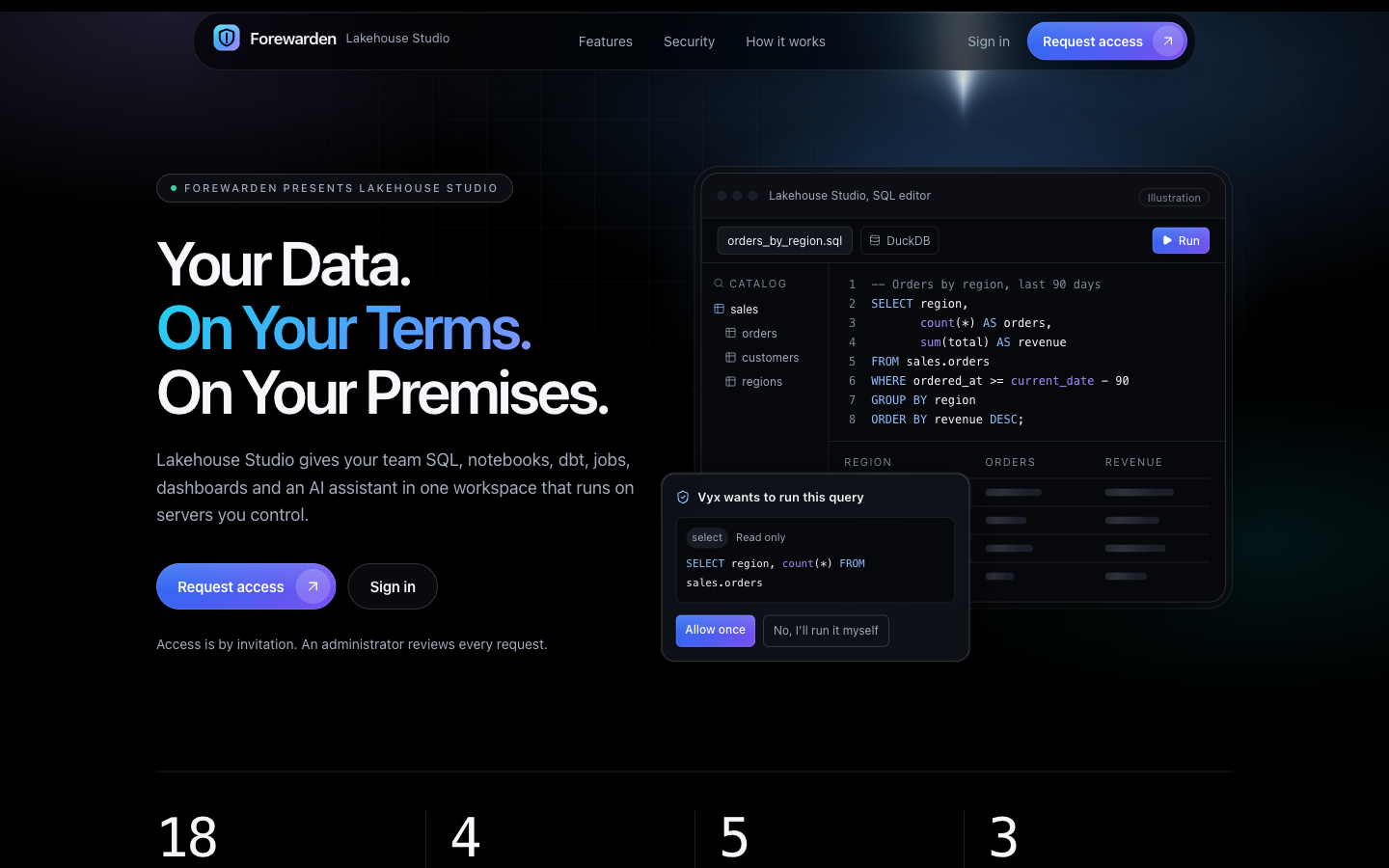
Honest status update: Lakehouse Studio is still being built. I have completed roughly the first 10% of the vision. What you see in the screenshots is real progress, and there is a lot more to come. If that makes you curious, keep reading, because there is a way to be part of it.
Why I Am Building Lakehouse Studio
Your data belongs to you
I do not believe in hosting company data on someone else's cloud. That is a personal conviction, not a marketing angle.
Your customer records, your financials, your operations data and your internal knowledge are the most valuable things your company has. Handing them to a third party, and then renting access back to them every month, never sat right with me.
Data should live where you can see it, touch it and control it. If you own the servers, you own the outcome.
Modern data tools assume you will move to the cloud
Platforms like Databricks, Snowflake and others are powerful. They changed how teams work with data. But almost all of them are designed around one assumption: your data will live in their cloud, or in a cloud they manage on your behalf.
For many organizations that assumption does not fit. Think about:
- Banks and financial firms with strict rules about where data can live
- Hospitals and healthcare providers protecting patient information
- Government and public sector teams with data residency requirements
- Manufacturers and defense suppliers guarding trade secrets
- Any company that simply wants control, and is tired of vendor lock-in
These teams still deserve a modern data platform. They should not have to choose between good tooling and keeping their data safe at home.
The cost problem
Cloud data platforms usually charge by usage. That sounds fair until your team grows, your queries multiply and the invoice becomes unpredictable. Budgeting for something that changes every month is hard.
With a self-hosted platform, you buy and run the hardware you choose. Your costs are known, and they stay known.
The gap I wanted to fill
There are plenty of open source building blocks for data work. But stitching them together into one smooth workspace that a whole team can use, with sign-in, permissions, a catalog, scheduling and an assistant, takes serious effort.
Most companies do not have the time to assemble that themselves. Lakehouse Studio is my attempt to close that gap: one in-house platform, in the spirit of Databricks, that runs entirely on your own infrastructure.
What Is Lakehouse Studio?
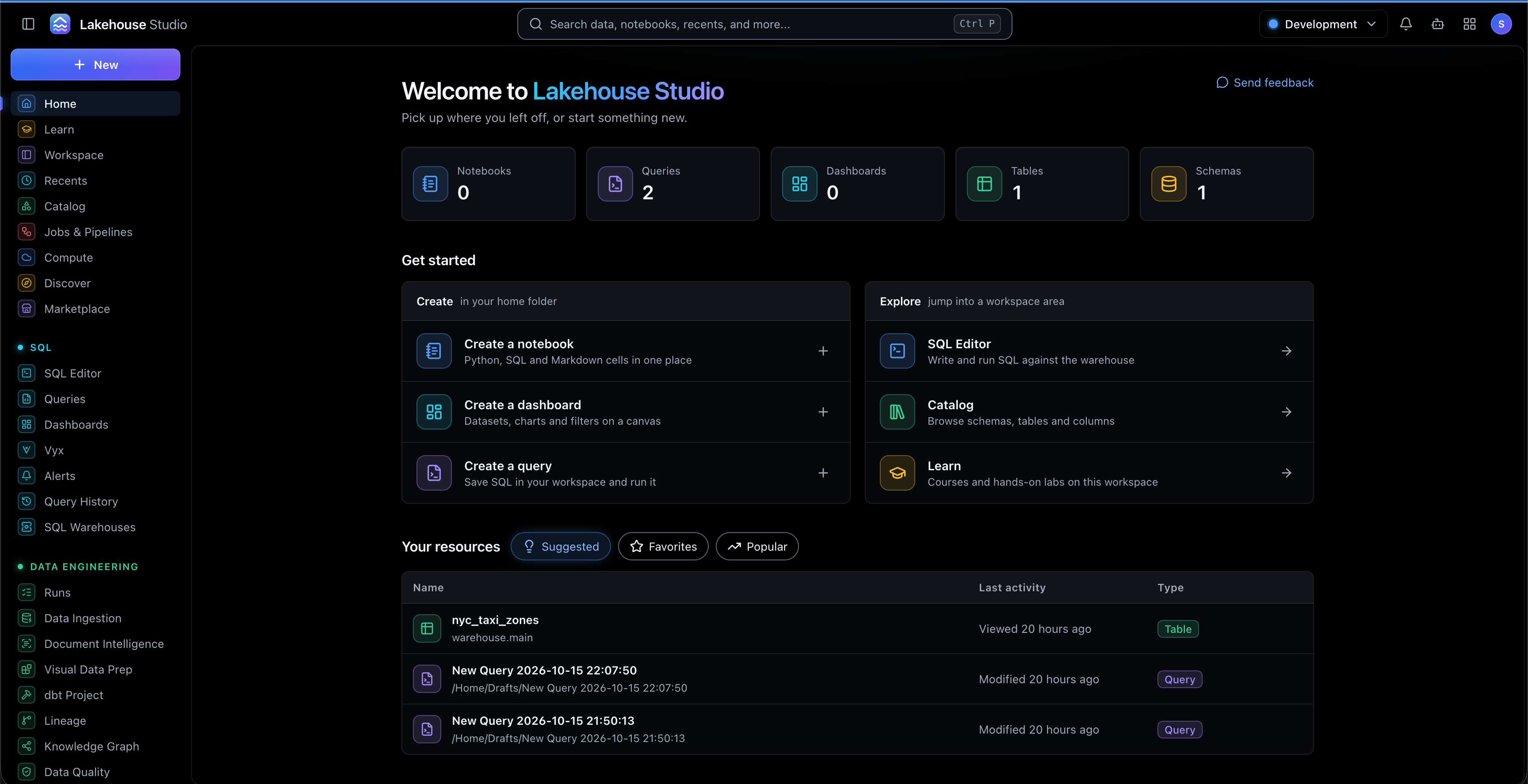
Lakehouse Studio is a self-hosted data and AI workspace. In plain terms, it is one place where your team can store data, explore it, clean it, analyze it, visualize it and ask questions about it, without that data ever leaving your network.
The word "lakehouse" simply describes a modern way of organizing data: the flexibility of a big data store combined with the structure and reliability of a traditional database. You get both in one system.
What You Can Do With Lakehouse Studio
Work with data using SQL and notebooks
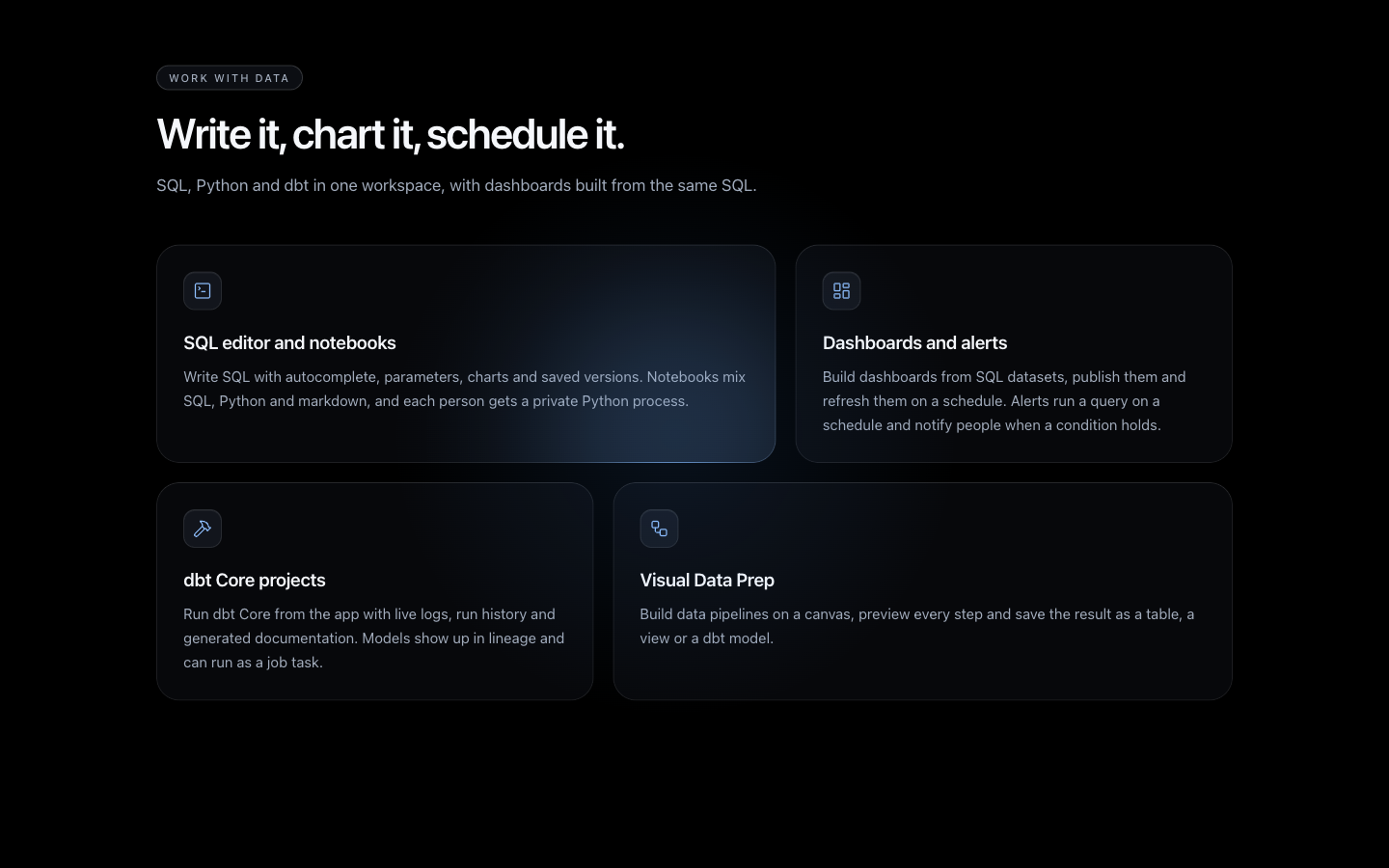
Write queries in a SQL editor with autocomplete, parameters, charts and saved versions. Prefer notebooks? Mix SQL, Python and notes in the same document so analysis and explanation live together.
Build dashboards and set up alerts
Turn a query into a dashboard, publish it for your team and have it refresh on a schedule. Set alerts so people are notified the moment something important changes, like a sales dip or a failed process.
Know where your data came from
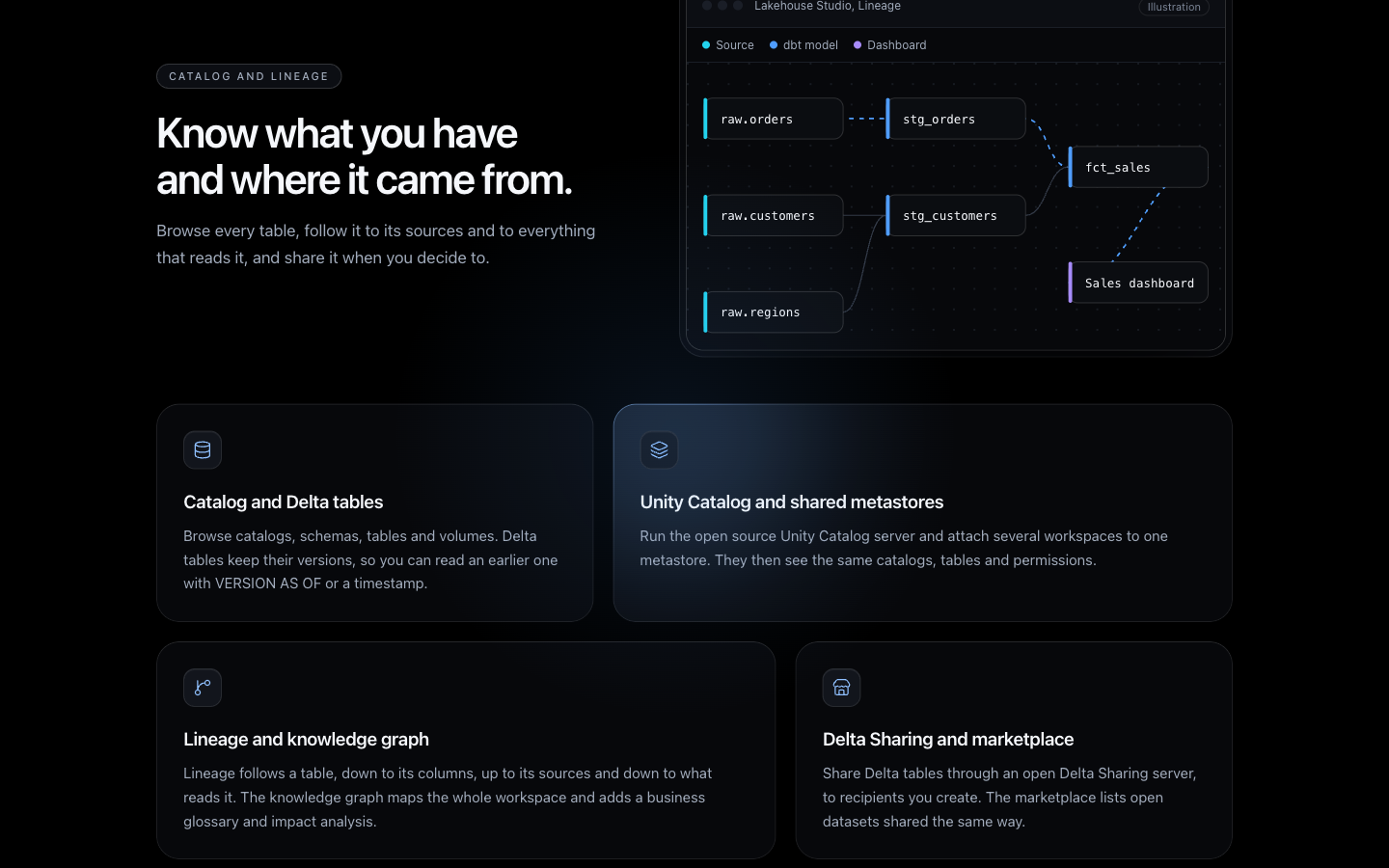
A catalog lets you browse every table, see where it came from and see everything that depends on it. This is called lineage, and it answers the question every data team eventually asks: "If I change this, what breaks?"
Ask questions in plain English with Vyx
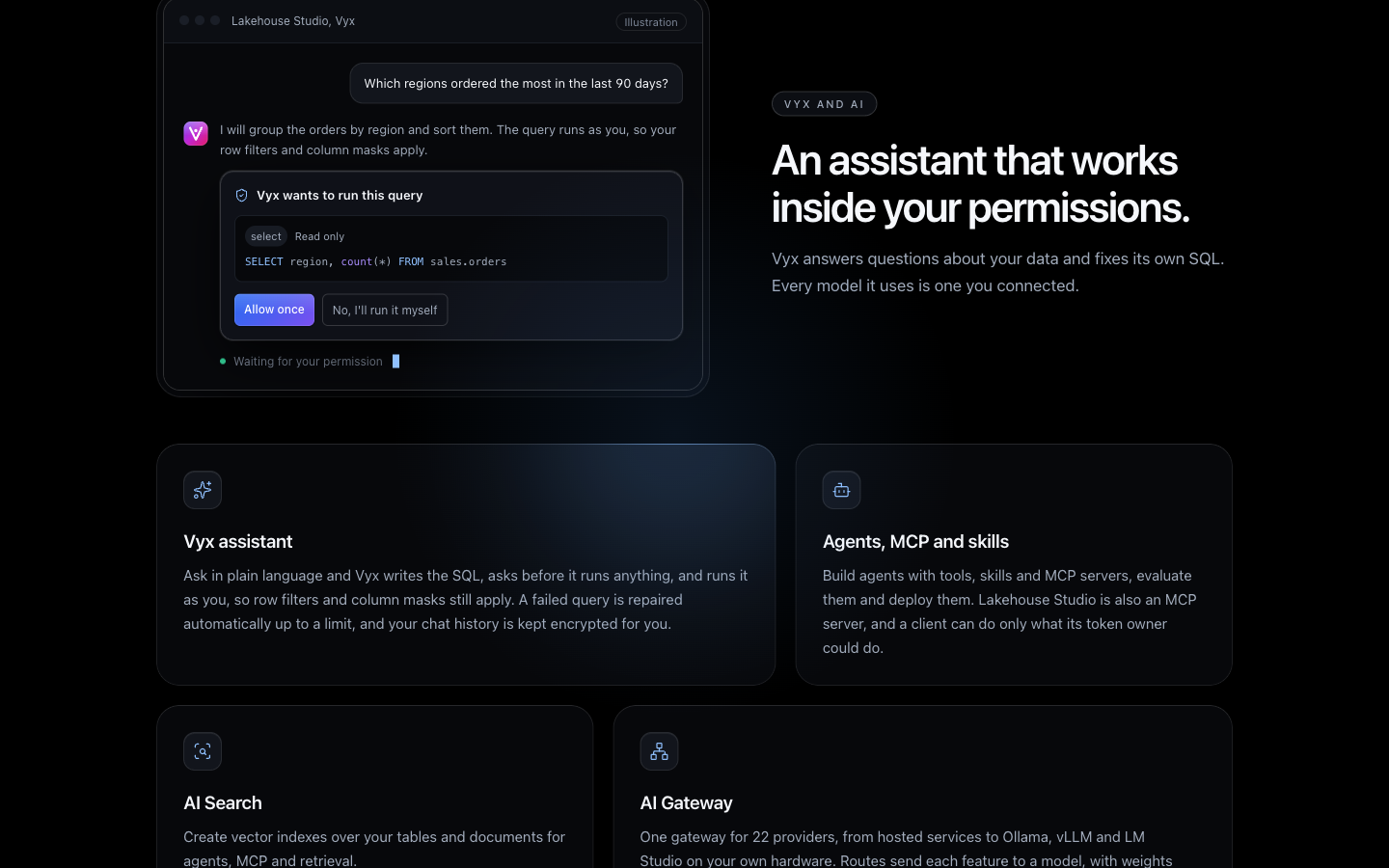
Vyx is the built-in AI assistant. Ask a question the way you would ask a colleague. Vyx writes the query, asks your permission before running anything, and runs it as you, so your access rules still apply. Nobody sees data they should not see just because they asked an assistant.
Build pipelines without the pain
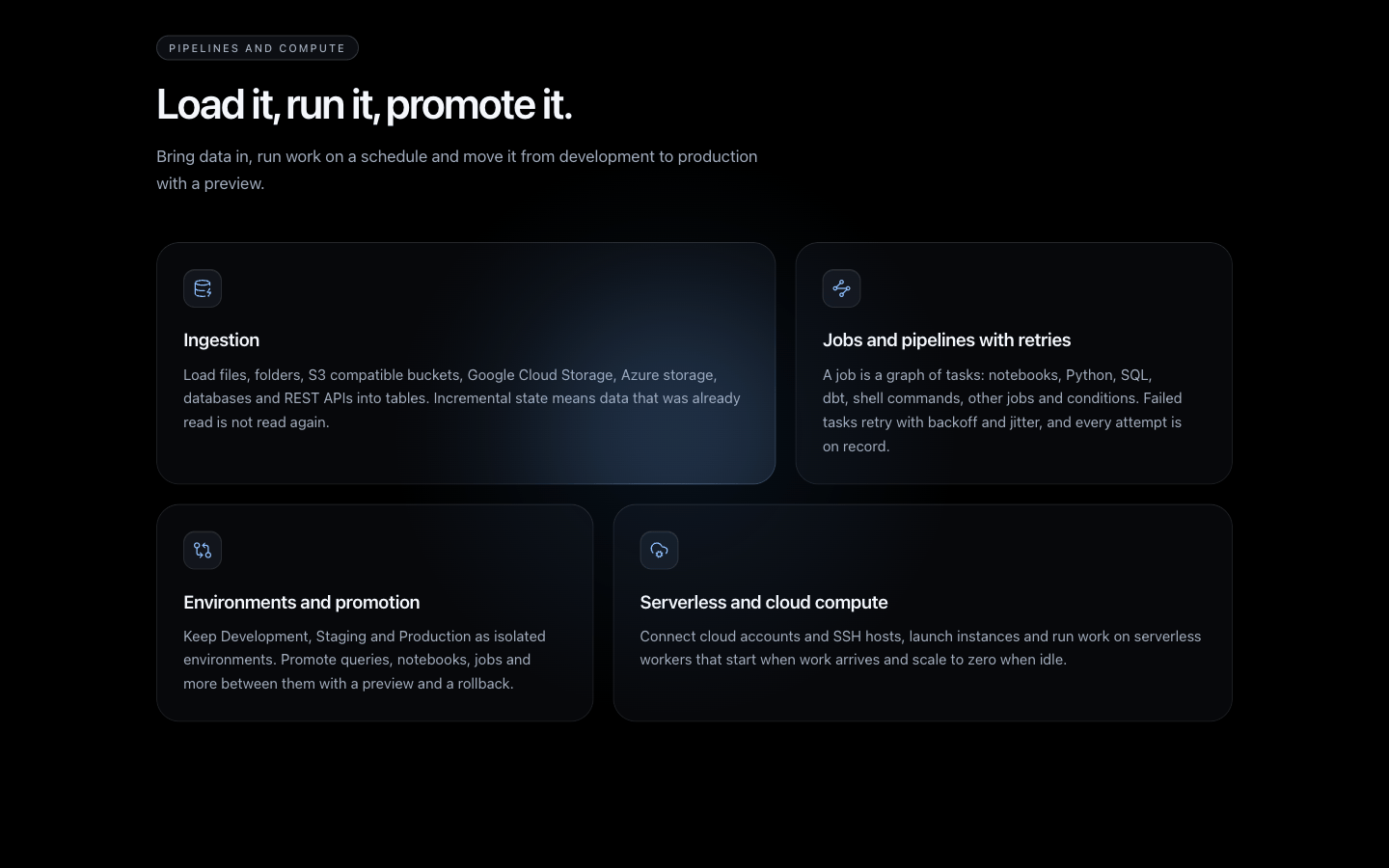
Visual Data Prep lets you build data pipelines on a canvas. You preview every step and save the result as a table, a view or a model. Schedule multi-task jobs with automatic retries, and keep Development, Staging and Production as separate environments with a clear path between them.
Bring your data in
Load files, databases, object storage and web APIs into tables, without re-reading data that has already been loaded.
Keep data trustworthy
Quality checks, anomaly monitors, data contracts and personal-data scanning help your team catch problems early and protect sensitive information.
Security and Governance Built In
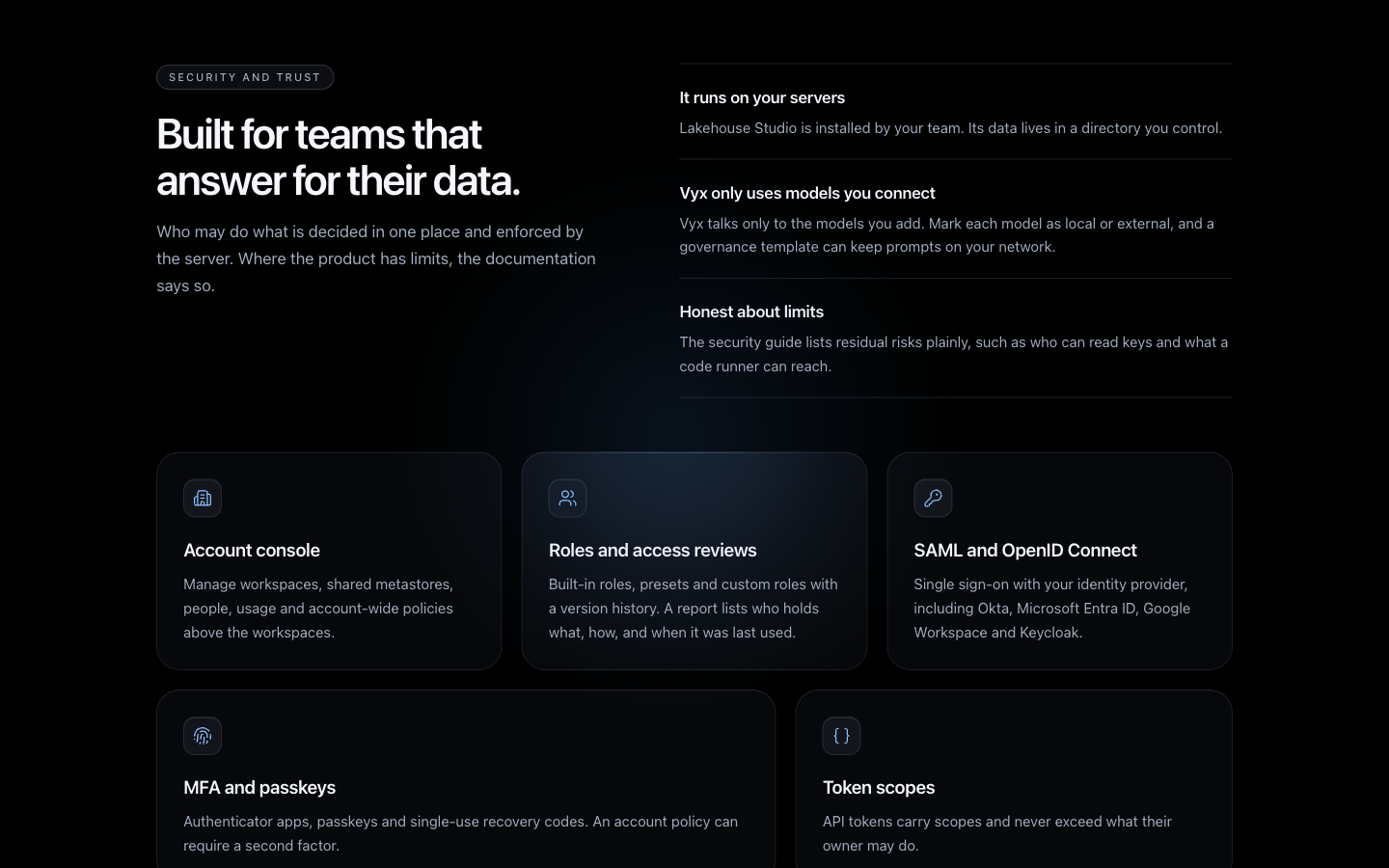
When you host your own data, security is your responsibility, so the platform should make it easier, not harder. Lakehouse Studio includes:
- Single sign-on, multi-factor authentication and passkeys
- Roles and permissions
- Row filters and column masks, so people only see what they should
- Scoped API tokens
- A full audit log of who did what
Who Is It For?
Lakehouse Studio is built for organizations that want modern data tools and full control:
- Companies in regulated industries
- Teams with data residency or sovereignty requirements
- Businesses that want predictable costs instead of usage-based billing
- Engineering and analytics teams tired of vendor lock-in
- Anyone who believes their data should stay on their own premises
Where Things Stand Today
I want to be direct about this. Lakehouse Studio is early. I have built about 10% of what I plan to build. The screenshots show real work, and some images on the product site are marked as illustrations using sample data.
The foundation and the direction are clear. The platform is not finished, and I would rather tell you that than oversell it.
Access is currently by invitation, and the project is proprietary, not open source.
The Opportunity: Acquire the Entire Platform
Here is something most builders would not say out loud: I am open to selling the entire Lakehouse Studio platform.
If you are a company, an investor or a team that shares the belief that data should stay in-house, this could be a head start. Instead of starting from zero, you would take over a working foundation, a clear product vision and a brand built around data ownership, then shape it into what your organization needs.
If you are interested, or just want to talk, reach out.
Frequently Asked Questions
Is Lakehouse Studio a Databricks alternative?
It is built in the same spirit: one workspace for SQL, notebooks, dashboards, pipelines and AI. The key difference is that it runs entirely on your own servers instead of in a vendor's cloud.
Does my data ever leave my network?
The design goal is that it does not. Lakehouse Studio runs on infrastructure you control, in your own data center.
Is it free?
My goal is to offer an in-house alternative without the usage-based cloud bills that come with hosted platforms. Access is currently by invitation. Contact me for the current terms.
Is it open source?
No. It is proprietary software. The showcase repository contains no source code.
Is it ready for production?
Not yet. It is in early development, with roughly 10% of the planned platform built.
Can I buy it?
Yes. I am willing to sell the entire platform. Get in touch to discuss.
Your Data. On Your Terms. On Your Premises.
Lakehouse Studio comes from a simple belief: the company that creates the data should be the one that controls it.
If you want a modern data and AI workspace that stays inside your walls, or you want to talk about acquiring the platform, I would like to hear from you.
- Website: lakehouse.sohaib.com
- Showcase: github.com/wcws-hq/lakehouse-studio-showcase
Built by Sohaib Khan.
Was this worth your time?